
A Chemicospiritual Dialectic
Cody's Film School Homework, Unit 1: Silent Film

Cinema’s origins are as mythic as anything out of the Vedas. A horse floats mid-gallop, settling a bet made by the man whose name graces the campus most responsible for constructing the all seeing eye of technological Providence; whirligigs and doodads exhibited at the World’s Fair evolve, within decades, into demiurgic engines of Maya; the prototypical Promethean businessman oversees the alchemical transformation of man’s frailty, as represented by a sneeze, into light refracted through eternity.
There’s great technical interest in the works of the first years of the cinema, but as art they’re pretty limited. I also don’t mean to rehash well-worn stories, so please forgive the coverage of stereotypical film school titles, especially here in the beginning of our tour. Nonetheless, the direction of the medium is impossible to understand without discussing these. It’s here, in the 1920s, that cinema begins to embrace its affinity with Dream Time.
(Something I skipped here, somewhat ironically, is American cinema of the 1910s; for example, I didn’t watch Birth of a Nation this week, not because I’m afraid of Confederacy apologia, but because it’s too damn long. I’m also, rather unfortunately, not discussing Charlie Chaplin, for no particular reason other than that I prefer Buster Keaton, who will, on my next assignment, offer me the opportunity to discuss the nascent entertainment industry as such. In school I always skated by, in prose much flashier than that of my classmates, by admitting to being a lazy student.)
Why we dream is not well understood. How we dream is better understood only marginally. Acetylcholine and dopamine generate signals in the forebrain that are registered as motion and color by the temporoparietal-occiptal junction of the neocortex. The material substrate of the brain, a medium altered by the chemical effects of light and electricity, conjures images that give the impression of a World seen from a limited vantage point, unfolding according to a logic not always obvious and subject to sudden change.
Our inability, while dreaming, to differentiate between waking shared “consensus” reality and private subjective experience is the very rupture through which cinema emerges. The rapid succession of still images through the projector mimics the classical idea that motion is a succession of frozen instants, a la Zeno’s paradox. The congruence between human perception and the zoetrope’s illusion renews ancient questions taken up by Gnostics, Hindus, and Taoists, and we will delve into that subject at length in due time. For now, take it for granted that the cinema externalizes the subjective process of perception, especially that of dreams, what with dreams’ peculiar dependence on narrative, their symbolic pregnancy, and their strange juxtapositions.
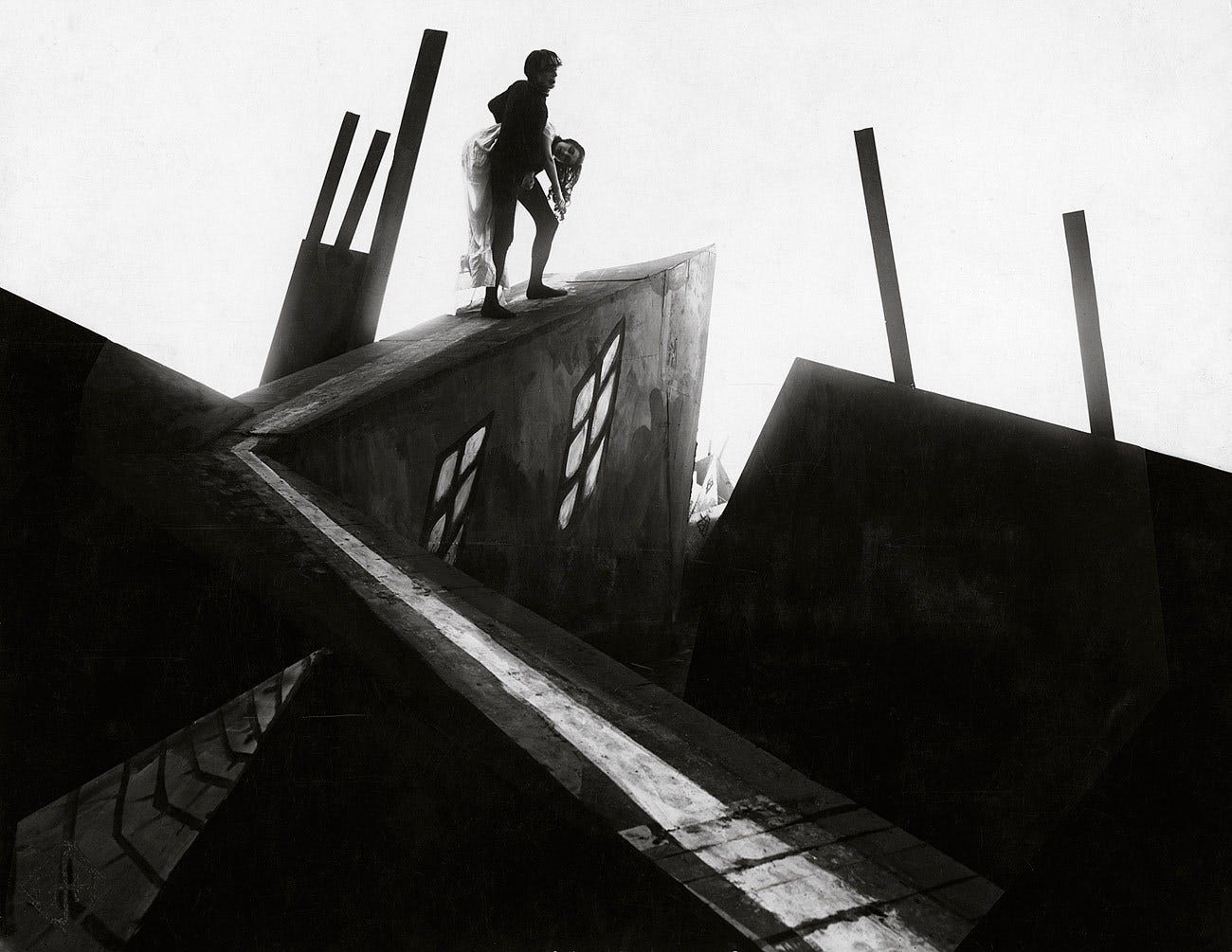
What’s interesting about European films in the 1920s, namely those of the German expressionists and of the Soviets, is that they each, in divergent ways, signal a certain self-consciousness about film’s oneirism. Montage had already introduced editing’s ability to convey narrative, collapse and dilate time, and, most significantly, give the camera omniscience—the ability to see the same duration from multiple viewpoints. These are advances on the malleability of dream perception. With the Soviets, montage’s capabilities are pushed to the point of transcendence, but with the German expressionists, the actual contents of the shot, the mise-en-scene, strove to liberate themselves from the expectations of the everyday.
Following the lead of modernist painting, filmmakers living in the center of the German speaking world (in contrast to American filmmakers in working class & immigrant peripheries) saw themselves as members of a haute culture awash in the heady developments of psychoanalysis, surrealism, and visual abstraction. They incorporated painterly and dramaturgical techniques for disturbing the visual field of the cinematographic shot. Proportions begin to warp in response to some new awareness of the image’s artificiality: the dream becomes lucid. Light and darkness struggle for equilibrium, each striving for its own perfected expression. Darkness never succeeds in quenching the light, but neither can light fully banish the irrationality of darkness. Within the rational container of four right angles, lines radiate, zig zag and cant like vectors of libidinal force moving within a space barely able to contain their chaos. This is not only the ethic of an art movement but the representation of an entire culture on the brink—Hitler joined the German Worker’s Party the same year that The Cabinet of Dr. Caligari was produced. As Europe sleepwalked its way into another catastrophe, the cinema dreamt up zombies, Svengalis, and automata.
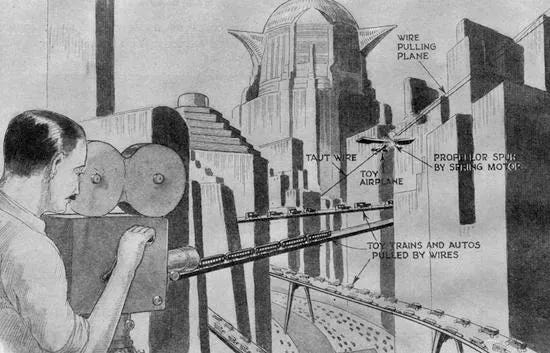
The image of projected movement, controlling the experience of the audience, clues the conscious mind into its own subjection. Much as the ego believes itself to be a source of self-directed potency, it ultimate depends on a vast cosmic machinery pushing and pulling it every which way. The beneficiaries of the System are no less dependent on it than those who are conscripted into its service. Moloch! the screen proclaims, before a hypermodern industrial apparatus transforms, hallucinogenically, into an ancient sacrificial pit. In a Metropolis such as this, “actors” is something of a misnomer. They do not “act” in the fullness of agency, but are herded along shoots, like livestock to slaughter, performing specific tasks in service of a semihuman industrial complex with billions of dollars as stake. The Director may achieve some higher level of consciousness—Freder serves as Lang’s stand-in, naively hoping to transform this slavery into salvation—but he wrestles with sinister forces, practices for manipulating the subconscious and reestablishing control. German expressionism is the nightmare of cinema, the conscious mind’s struggle with an irrationality that will not be neatly sublimated.
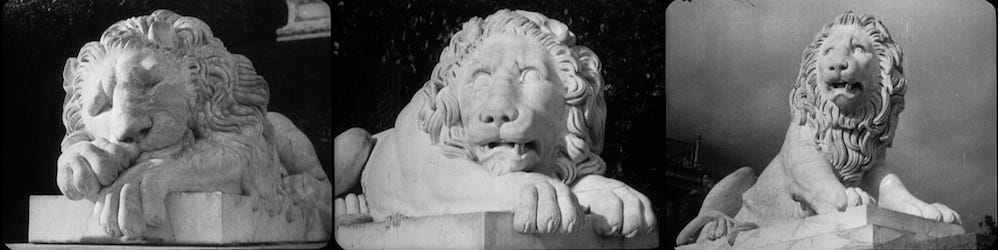
While Metropolis presents a vision of modernity as a reemergence of esoteric hierarchies—the consummation of Atlantean black magic—Soviet cinema sought a utopian use for the technoindustrial world. Rather than find inspiration in the bourgeois theatre and plastic arts, Eisenstein saw in DW Griffith’s employment of montage an undeveloped expression of dialectical materialism. By rapidly juxtaposing, not in sequence but in superposition, contrasting images, thesis-antithesis, a compound meaning arises: synthesis. Sailors moving in opposing directions man the machinery of the Battleship Potemkin; the crew as heterogeneous unity overcome the isolated whims of the captain; a statue of a lion appears to rise from its slumber, aghast at the massacre of the Ukrainian people at the hands of Cossacks. It is in the interval between these images that narrative is created by the subconscious, much as a dream has an immediate logic despite leaps and lacunae not usually tolerated by the waking mind. This transcendence is only possible by seeing in the technology of film a comrade of human intelligence.
Where Vertov parts with Eisenstein is in a radical acceptance of this possibility. Human and industrial activity operate on the same plane, meaning that the dialectic is a mutual process moving towards chaotic ends. There’s no guarantee, no matter what Engels, Marx or Lenin say, that the contradictions resolve into a particular political program. The oscillation between machine and man, between human and nonhuman perception, attains a self-consciousness. Material creates images, images create material, and full-blown manic psychosis ensues. To attain that level of reality-warping power is not a smooth transition, involving, as it does, the entirety of human-organic-industrial relations. Man with a Movie Camera could very well be entitled Movie Camera with a Man. People become cogs in vast machineries, Metropolis style, but machineries themselves also desire to express the fullness of their capabilities, like all organisms do. The cinema now calls us to live in a higher dimension, where familiar distinctions lose their meaning: fiction and documentary, dream and reality.